
Competitive Intelligence Analysis of Dominican University and Chicago State MLIS Programs
For those interested in pursuing a career in Library Science, a Master of Library and Information Studies degree can be a powerful career tool. A program that is accredited by the American Library Association (ALA) holds a significant advantage over non-accredited programs when attracting prospective students. In the Chicago-land area there are only two ALA accredited MLIS programs: Dominican University (DU) and Chicago State University (CSU). In order to better understand the strengths and weaknesses of Dominican University’s MLIS program it will be beneficial to compare Dominican’s program to Chicago State’s program, not only because they are the only two ALA accredited programs in the geographic area, but also due to their similarity in cost and enrollment population.
When comparing academic programs an important component to examine is the faculty. DU lists twelve faculty members belonging to the MLIS program. Of those faculty members four hold PHDs in Library and/or Information Studies, eight hold unidentified PHDs, and eight hold MLIS degrees.[1] CU MLIS program lists five faculty members and one staff member. Of the faculty members three hold PHDs in LIS, one holds a PHD in Radio/TV/Film, one holds a PHD in Electrical and Computer Engineering, and two hold MLIS degrees.[2] Not only does DU employ a faculty over twice the size as CU, but DU’s faculty demonstrates a higher level of expertise with a total of twelve post-bachelor degrees directly related to LIS compared to CU’s five.
The course offerings of an academic program are another essential factor to consider. DU and CSU’s programs have similar required courses focusing on organization of information, foundations and values of librarianship, and library and information technology. The programs differ in their approach to elective courses. CU’s program requires the student to choose a focus of study: Academic Libraries, Public Libraries, School Libraries, or Archives and Records Management. Once chosen, the student completes a specific set of “directed electives”, and depending on the focus of study, may take two to four electives of their choosing.[3] In contrast, DU allows the student to choose their electives without a declared focus of study. Both approaches have benefits and drawbacks. CU’s directed path may feel too rigid for some students who wish to explore more than one focus and obtain a flexible degree that will translate to various library environments or information professions; however for those seeking a specific type of degree this approach offers explicit guidance. DU gives student’s freedom to chose their own electives and explore multiple facets of library and information science; however students may feel overwhelmed by the numerous choices, and the lack of institutional direction may hinder the development of a cohesive and well rounded course load.
A program’s cost is often a determining factor for students. CSU is a more affordable option for Illinois residents with the total cost of tuition and fees ranging from approximately $15,500 to $18,500. Out of state students will pay considerably more with costs ranging from approximately $26,000 to $32,000. DU doesn’t discriminate between in-state and out-of-state students with the total tuition and fees for all MLIS students approximately $31,200.
External factors such as web presence and public interest must also be compared. Appendix H shows a Google search of the “Chicago Library Science” and “Chicago Library and Information Science” in which CSU ranks third and first (respectively) and DU ranks eighth and fourth (respectively). While both programs appear high in the results, CSU has a distinct advantage in appearing above DU in both instances. Using similarweb.com to examine both universities overall web traffic, Appendix A shows DU outranks CSU in US, Global, and the Science and Education University category; however the difference between their rankings is slight making their overall ranking relatively equal. Appendix B charts each site’s traffic over the last 6 months, and again both universities perform relatively the same. DU leads with more Total Visits, Average Visit Duration and Pages Per Visit; while CSU reports a lower bounce rate. The difference between the universities is not significant with both performing at relatively the same level with the exception of the bounce rate. DU’s bounce rate is 15.13% higher, which may result from the existence of other unrelated universities including “Dominican” in their name. Appendix C illustrates the Google search trends for each university in the US and worldwide; trend lines demonstrate that on average both universities perform relatively the same.
Appendix D shows the source distribution of web traffic for each university. DU displays a more varied distribution while CSU depends primarily on Direct and Search Traffic. Neither university displays significant social media traffic, however CSU’s social media traffic accounts for less than 1% of their total web traffic indicating a significant missed opportunity to attract and engage with current and prospective students. DU performs only slightly better at 7.36%. Appendix E breaks down social media traffic by platform. Again, CSU’s performance is abysmal with 100% of social media traffic directed from Youtube. YouTube, Facebook and WhatsApp make up the majority of DU’s social media traffic with over half originating from Youtube and roughly 17% from Facebook and WhatsApp, respectively. When examining the presence of each university on popular social media platforms, Appendix F finds that CSU receives significantly more mentions across the board while DU’s mentions indicate a significant lack of presence and engagement.
Appendix G shows the instances of keyword “MLIS” on each universities website. Six results were found for CSU and four hundred and eighty one were found for DU. The significant difference suggests DU is more proactive and aggressive in their promotion of their MLIS program, devoting more web real estate to the program resulting in more search hits. The relatively insignificant hits found on CSU’s site suggest their MLIS program ranks low of their overall priorities.
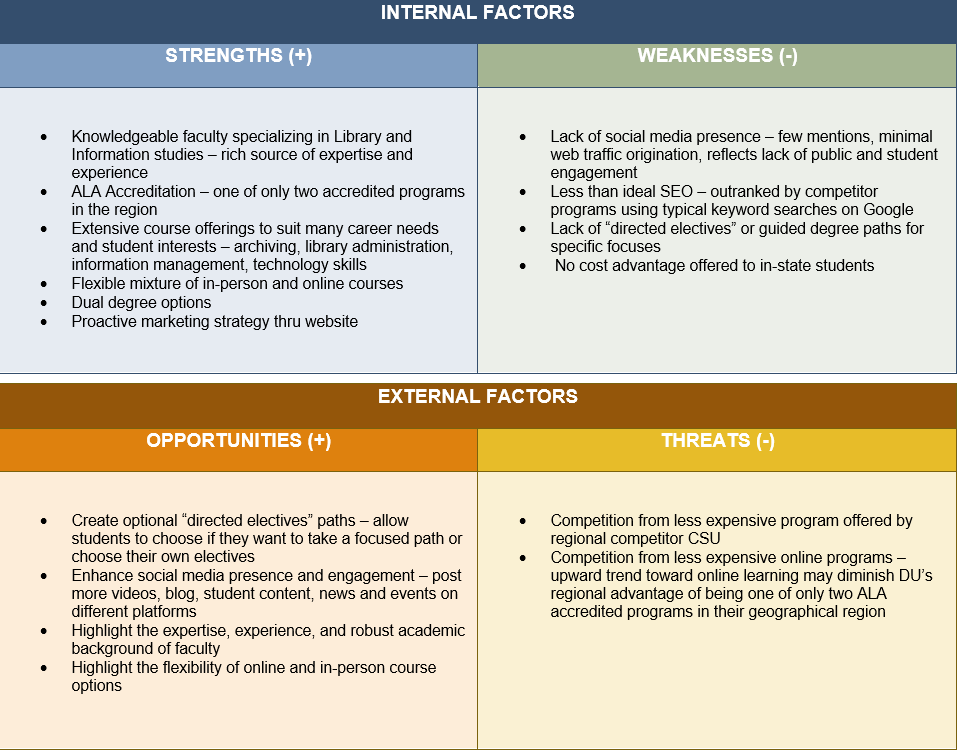
Below you will find a summary SWOT analysis of DU’s MLIS program based on the discussed findings.
Appendix
[1] Dominican University, accessed 2/16/2021, https://www.dom.edu/admission/graduate/library-information-studies-programs/faculty
[2] Chicago State University, accessed 2/16/2021, https://www.csu.edu/collegeofeducation/infomediastudies/facultyandstaff.htm
[3]Chicago State University, accessed 2/16/2021 https://www.csu.edu/catalogs/documents/GraduateSchool_catalog_2020-21.pdf
 Nora Ambrosius